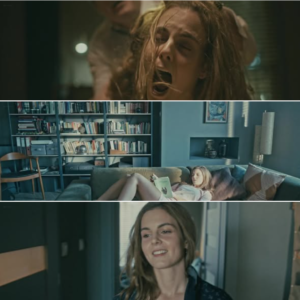
A Higher Law (2021) steps into a world where duty, desire, and morality collide in ways that feel both unsettling and deeply human. The story centers on a high school Religion teacher, married to the local priest, whose carefully ordered life begins to crack when she becomes entangled with Iuliu, a 16-year-old student marked by hardship and emotional scars. The film immediately signals that this path is dangerous, and it treats the subject with a somber weight from the start.
Rather than chasing sensationalism, the film explores the psychological landscape of forbidden connection. The teacher’s life, once defined by spiritual structure and community expectations, starts to unravel as personal longing pushes against the boundaries she was sworn to uphold. Every glance, silence, and moment of hesitation carries the tension of a life drifting off its axis.

Iuliu’s presence becomes a catalyst rather than a romantic ideal. The film portrays him with vulnerability and complexity, showing how troubled pasts can create echoes that pull people into unhealthy emotional territories. His interactions with the teacher serve as mirrors—reflecting loneliness, unmet needs, and the human tendency to search for comfort in the wrong places.
Visually, A Higher Law uses muted tones and close, quiet framing to heighten the sense of confinement. The town feels wrapped in ritual and expectation, making the characters’ internal conflicts feel even sharper. Shadows, narrow hallways, and winter light weave into the narrative, creating an atmosphere where every action feels irreversible.
Performances add emotional depth to this fraught story. The lead actress brings a restrained intensity, showing the slow erosion of moral clarity with gestures as small as a trembling breath. The film never asks the audience to justify her choices; instead, it invites viewers to sit inside the discomfort and understand the psychological spiral that leads her there.